- (302) 616-2906
- [email protected]
- 30430 Cedar Neck Road Ocean View, DE 19970
- Available 24/7

Heating Maintenance in Ocean View, DE
The point of a fall tune-up is to find the thing that would have failed in January, while it is still September and nobody is cold.
- Licensed & Insured
- 12-Month Workmanship Warranty
- 24/7 Emergency Service
Heating
On a Heat Pump, the Fall Visit Is Not a Filter Change
Most houses here heat with the same box that cools them, and that changes what a heating tune-up should actually look at. The parts that strand people in a cold snap are the reversing valve, which is what flips the system from cooling to heating, and the defrost control, which clears ice off the outdoor coil. Neither gets used at all between April and October, and neither announces itself until the night you need it.
Then there’s the coil. Two miles from the ocean, salt pits the contactor and eats the fins on the outdoor unit, and a coil that has lost a chunk of its surface area doesn’t move as much heat. That happens gradually, so the system doesn’t fail. It just quietly costs more and works less, and the first winter you notice is usually several winters after it started.
Timing matters more here than the frequency does. Book it before the first hard freeze rather than after, because the week the temperature drops is the week everyone calls, and a part that is a scheduled visit in October is an emergency in December.
Every technician who turns up at your door is background-checked, and we clean up before we leave.
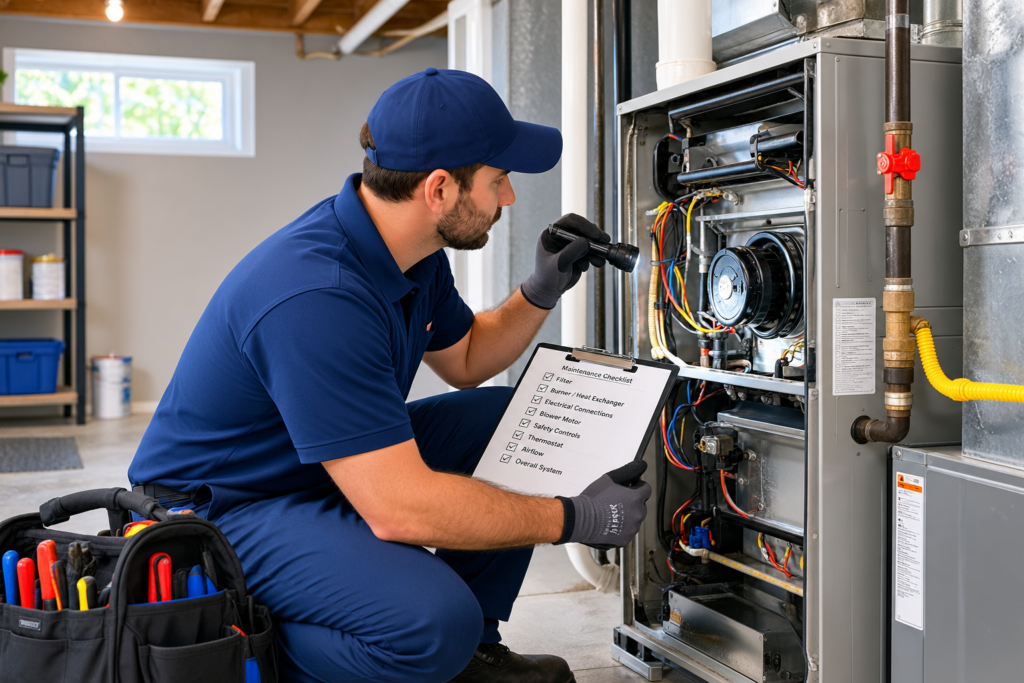
What Matters Going Into Winter
01
The heat pump side
Reversing valve and defrost control first, because those are the two that only matter in winter and only get tested in winter. Then the outdoor coil and the contactor, which are the two the salt gets to. Then airflow, refrigerant charge and the electrical connections, which matter in both seasons.
02
The Furnace Side
On a propane furnace, the heat exchanger, the burners, the flame sensor and the flue. A cracked heat exchanger is the one item on any of these lists that is a safety issue rather than a comfort one, and it is the reason a furnace inspection is not optional in the way a coil rinse is.
03
Ductwork & Airflow
Filters, returns and anything obviously wrong with the duct runs. If one end of the house never gets warm, that is nearly always distribution rather than equipment, and no amount of tuning the unit will fix it.
04
A House That Sits Empty
If you won’t see the place until April, the useful version of this visit is different. It is about what fails unattended: a system that won’t restart, a condensate line that freezes and backs up, a thermostat set somewhere that costs a fortune for four months. Tell us the house is empty when you book and we’ll look at it that way.
Where We Work
Areas we serve
Based on Cedar Neck Road in Ocean View, covering Sussex County and the shore communities around it. If the house is empty and you need someone let in, say so when you book and we’ll work out access before the day rather than on it.
- Ocean View, DE
- Millville, DE
- Frankford, DE
- Rehoboth Beach, DE
- Bethany Beach, DE
- Selbyville, DE
- Dagsboro, DE
- Lewes, DE
Don’t see your town? Call us – we travel.
Good to Know
Heating Maintenance Questions We Get Asked
Can’t see vours? Call and ask – we’d rather answer than have you guess
When should I book the fall visit?
September or October, before the first hard freeze. Not because something bad happens on a date, but because the week the temperature drops is the week the phone does not stop, and a worn part found in October is a scheduled visit while the same part in December is a night without heat. If you are past that window, book anyway. Later is better than not.
What actually gets checked on a heat pump?
The two that only matter in winter come first: the reversing valve, which switches the system from cooling to heating, and the defrost control, which clears ice off the outdoor coil. Then the outdoor coil and contactor, which take the worst of the salt here. Then airflow, charge and electrical connections. A filter change is part of it and it is the smallest part of it.
Does a heat pump need servicing twice a year?
It is the same machine doing two jobs, so there are two sets of parts that only matter in one season each. Whether that justifies two visits depends on the system’s age and how hard it works. An older unit or a rental that runs all summer, probably. A newer system in a house occupied part of the year, one visit before winter is a reasonable call, and we would rather say that than sell you a second one you do not need.
My system is running constantly in cold weather. Is that a maintenance problem?
Usually it is not a problem at all. A heat pump runs long and steady when it is cold and the air from the vents feels cool against your hand even while the house is warming. That is normal. What is not normal is ice that stays on the outdoor coil through a full defrost cycle, a system that cannot hold the temperature you set, or emergency heat switching on by itself. Any of those three, call us.
What can I do myself between visits?
Two things, and they matter more here than inland. Change the filter on whatever schedule the house actually needs rather than the one on the box, because a coastal house with the windows open in spring loads a filter faster. And rinse the outdoor coil with fresh water a couple of times a year with a hose, gently and from the outside in. Salt is what kills these units, and rinsing it off is free.
Are you licensed and insured in Delaware?
Yes. We’re insured and bonded, and we carry a Delaware HVACR license.
Ready to get started?
We answer the phone 24 hours a day, every day of the year